If you’re already thinking in Generative Engine Optimization (GEO) terms, you’ve probably hit the same wall we see everywhere: traditional SEO reporting doesn’t fully capture the nuanced mechanics of how LLMs (Large Language Models) synthesize and surface information.
At BMG360, we’re still measuring rankings, but we’re more focused on the probability of synthesis. Our GEO framework is built on a tripartite model: earning Selection, Citation, and Clicks across AI surfaces. To move the needle on these metrics, you must transition from keyword density to semantic authority.
The shift from “earning traffic” to “being selected”
A useful way to simplify reporting is to align to the outcomes as the GEO target state:
- Selected: presence + topic coverage across your prompt/query set (if/how you show up in AI answers)
- Cited: citation count + citation coverage + top cited pages (where you’re referenced as a source)
- Clicked: organic performance trends, segmented by brand/non-brand and page groups (you still earn the visit when it makes sense)
The Three Pillars of GEO Performance
To improve performance against modern AI metrics, your content strategy must shift from “writing for users” to “architecting for agents.”
1. Selected: Moving from “Presence” to “Preference”
Selection is the baseline: Is your brand part of the LLM’s training set or RAG (Retrieval-Augmented Generation) pull? To be “selected,” you must optimize the technical and semantic scaffolding of your content.
Semantic Optimization & Multi-Vectorization: AI doesn’t see words; it sees vectors. To be selected, your content must be optimized for semantic proximity. This means building clusters of related concepts that allow the engine to map your content to a user’s intent from multiple angles.
The Importance of Authorship & Schema: LLMs prioritize verified entities. We implement Person and Organization schema to explicitly define the expertise behind the content. High-performance GEO requires clear authorship signals – linking content to recognized experts – to give the engine the confidence to select your data over a generic competitor.
2. Cited: Earning the “Proof Point” of AI Trust
Citations are one of the strongest indicators of AI trust. Being cited is the digital equivalent of being called as an expert witness by the AI.
The “Authoritative Hub” Strategy: To be cited, you must be in the conversation beyond your own domain. If the authoritative hubs in your niche (industry journals, high-authority news sites, specific forums) aren’t mentioning or linking to you, the LLM perceives a lack of consensus.
Citing Authoritative Sources: Paradoxically, citing other high-authority, relevant sources within your own content can improve GEO performance. It signals to the AI that your content exists within a high-value neighborhood of information, increasing the likelihood of being cited as a peer-level resource.
3. Clicked: Attribution in a “Clickless” Answer World
Clicks still matter, but they’re no longer the primary KPI. Think of them as the conversion of trust. While AI Overviews (AIO) aim to answer queries in-platform, high-intent users will still click through for deep-dive validation or transaction.
GEO metrics are less about traffic or impressions from specific keywords and more about topical clusters (so not all is lost, we were already moving in this direction with traditional SEO).
Here are the SEO metrics we think are worth keeping:
- Organic sessions (segmented by intent and page type)
- Non-brand vs. brand search performance
- Conversions attributed to organic (and assisted, if you report it)
And some new additions:
- Advanced Attribution & GA4 Tracking: You cannot manage what you cannot measure. Because GA4 doesn’t natively label AI traffic perfectly, you need custom tracking solutions to prove value.
- Isolating AI Traffic: We utilize specialized configurations to track traffic from AIO, Featured Snippets, and PAA (People Also Ask) results. By segmenting LLM-chatbot traffic separately in GA4, we can demonstrate growth in AI-driven referrals even when traditional organic search looks flat.
- Sentiment Analysis: When GPT cites your brand, what percentage of citations are positive, negative, or neutral? This matters even more in a GEO world, where your brand is represented in a snapshot response.
The BMG360 Practical Reporting Structure
To land this with stakeholders without unnecessary complexity, we report monthly in three distinct performance blocks:
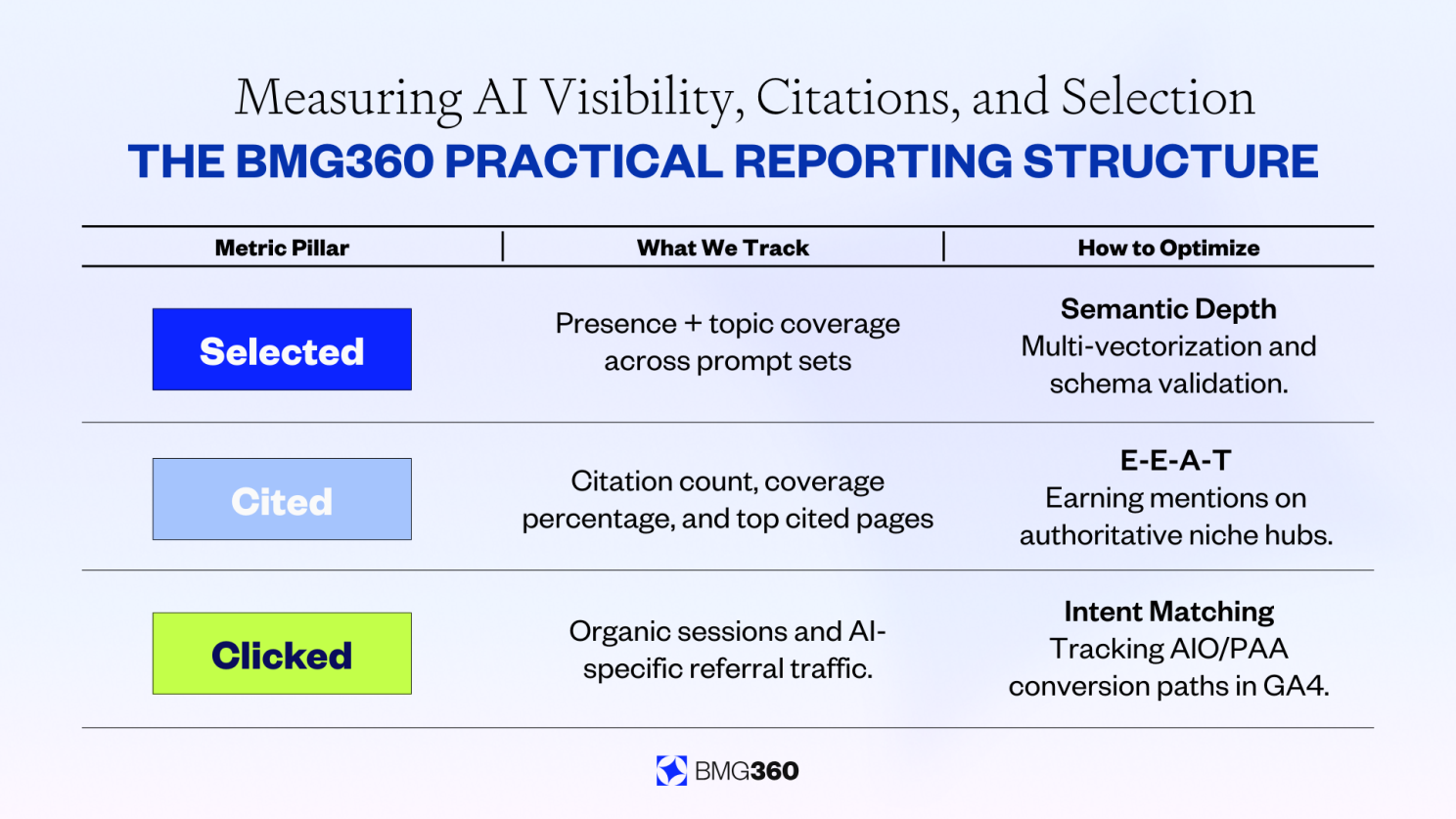
GEO is the combined future of visibility across SEO + AIO. By focusing on semantic optimization to get selected, authority building to get cited, and advanced attribution to track what’s clicked, BMG360 ensures your brand is both found and recommended.
Want to talk AI visibility? Get in touch with Reggie Sudduth II or Mark Aspillera!
